
What are the differences between Manual, Machine and Automated Welding you ask? Wonder now more, we’ve got the answers for you!
Machine welding is a process where the welding parameters and the physical movement of the torch are controlled by mechanical means under the constant observation of an operator. Unlike manual welding, the machine performs the weld, while the operator performs manual adjustments to the controls to maintain weld quality. This process serves as the bridge between traditional manual labor and fully autonomous robotic systems.
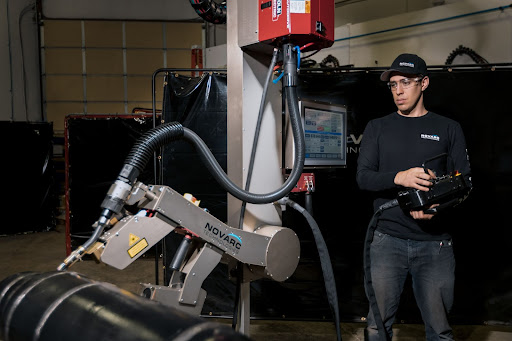
Machine Welding vs. Robotic Welding: Key Differences
While both systems move the welding process away from manual hand-held torches, they differ significantly in autonomy and efficiency:
- Human Intervention: Machine welding requires an operator to stay at the station to adjust variables in real-time. Robotic welding uses pre-programmed logic to handle complex paths and variations without constant manual input.
- Flexibility: Machine welding is typically dedicated to a single, repetitive task (like a simple longitudinal seam). Robotic systems, like the Novarc SWR, can handle various pipe diameters and joint configurations.
- Productivity: Robotic welding offers a higher “arc-on” time because the system does not need to pause for human recalibration between every weld.
According to the ASME B&PV Code, Canadian CSA W59 and CSA W47.1, there are four modes of welding process applications:
1. Manual Welding
Welding whereby the entire welding operation is performed and controlled by hand. Since the welder does all the work manually, it’s physically demanding and can lead to repetitive injuries.
2. Semi-Automatic Welding
Semi-automatic welding is manual welding with equipment that automatically controls one or more of the welding conditions. The welder manipulates the welding gun to create the weld while the electrode is automatically fed to the arc.
3. Machine (Mechanized) Welding
Welding with equipment which needs operator manipulation or adjustment in response to changes in welding condition. The torch, gun, or electrode holder is held by a mechanical device and the mechanical device that holds the gun, torch or electrode can be a robot (we’d suggest the Spool Welding Robot – but that’s just us!).
4. Automated Welding
Welding with equipment that needs only occasional or no observation of the weld, and no manual adjustment of equipment controls. For this type of welding, the welder’s activity is starting the machine and watching for defects or issues that need correction.
Bonus
5. Robotic Welding
Welding performed and controlled by robotic equipment which requires no involvement from the welder. The welder’s main function in robotic welding is to maintain quality control and fix any deviations or issues.
The Most Frequently Asked Question – A Recap
What is the difference between machine welding and robotic welding? Machine welding involves a mechanical device performing the weld while a human operator provides constant monitoring and adjustment. Robotic welding is a more advanced form of automation where a programmable robot performs the weld independently using sensors and AI to adapt to the environment, requiring significantly less human intervention.