
A world leader in Printed Circuit Heat Exchangers (PCHEs) recently partnered with Novarc Technologies to test the capabilities of the Spool Welding Robot (SWR™) on challenging compound bevel configurations. At the company’s request, they will remain anonymous in this report. The trials, conducted at Novarc’s Houston Customer Experience Center (CXC), demonstrated that the SWR can achieve exceptional weld quality even under demanding geometries and thick-wall conditions, laying the groundwork for future stainless steel development. Novarc is taking robotic welding to new heights, see how below
Overview
Customer: Anonymous Printed Circuit Heat Exchangers (PCHEs) Company
Objective: Test Novarc’s Spool Welding Robot (SWR™) on thick-wall, compound bevel joints in carbon steel before moving to stainless steel.
Trials Conducted:
Trial 1: 3” SCH 160 pipe
Trial 2: 6” pipe, 30 mm thick with 37.5°/10° bevel
Trial 3: 6” pipe, 60 mm thick with dual 37.5°/10° bevels
Results and Key Takeaways:
- All welds passed ASME Section IX radiography testing.
- Minor porosity only; no fusion or structural defects detected.
- Demonstrated SWR’s ability to adapt to tight bevel geometries and thick-wall conditions.
- SWR proved successful in all trials, ready for stainless steel testing.
Next Step: Continue to stainless steel trials
Background and Objectives
This company’s advanced heat exchangers operate in some of the world’s most extreme environments, from LNG and hydrogen to oil & gas and carbon capture systems. Their components often feature complex weld geometries and materials up to and exceeding 3 inches thick, requiring precision, repeatability, and compliance with stringent quality standards such as ASME Section IX.
To evaluate whether Novarc’s SWR could handle these requirements, the company provided machined carbon steel coupons with unique bevel configurations for testing. The goal: prove the SWR’s ability to produce defect-free welds across various joint types before moving on to stainless steel trials.
Trial Overview
Three separate welding trials were completed, each simulating real-world production conditions:
- Trial 1: 3” (DN 75) pipe, 37.5° to 25° bevel, 22 mm (.87 in) wall thickness
- Trial 2: 6” (DN 150) pipe, compound 37.5°/10° to 25° bevel, 30 mm (1.2 in) thickness
- Trial 3: 6” (DN 150) pipe, compound 37.5°/10° bevel on both sides, 60 mm (2.4 in) thickness
Each weld was performed using combinations of GTAW, GMAW, and GMAW-STT processes on Novarc’s SWR, with radiographic testing (RT) used to validate weld integrity.
Trial 1: Carbon Steel 3” (DN 75) Schedule 160 Pipe (0.87 in)
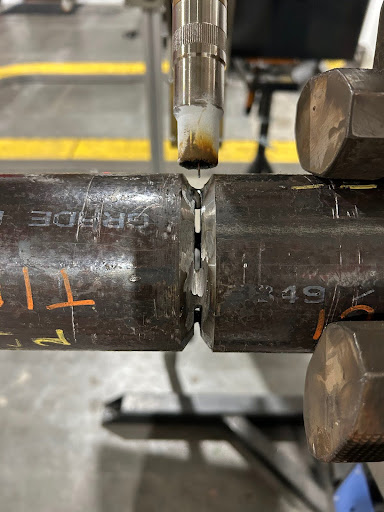
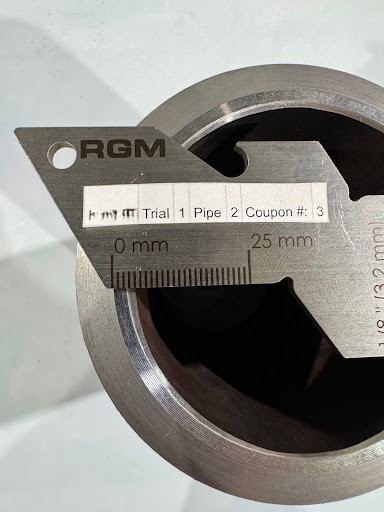
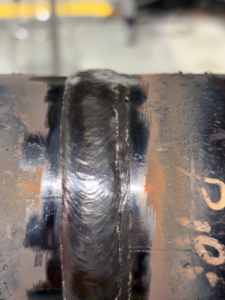
In the first trial, Novarc’s team, led by Director of Welding Applications Alexander Purvis and Jr. Welding Engineer Ryan Reed, achieved successful results despite challenges from an oversized land (5 mm) and back chamfer. These required precise control of torch position to avoid collision risks. The weld took 5 minutes and 30 seconds to complete with a total of 4 passes.
After adjustments, the welds displayed full root penetration. Radiographic inspection revealed only a single minor indication of subsurface porosity (0.063”), well within ASME acceptance limits. Novarc recommended optimizing the land thickness to 1.5–2 mm for future consistency.
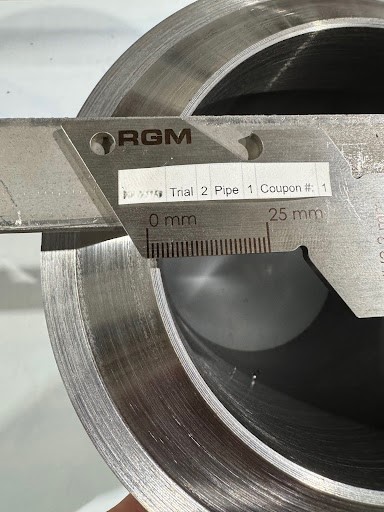
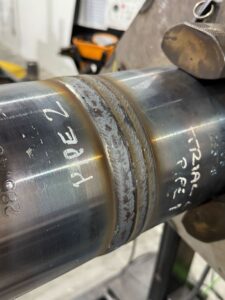
Trial 2: Carbon Steel 6” (DN 150) 30 mm (1.2 in) Asymmetrical Compound Bevel
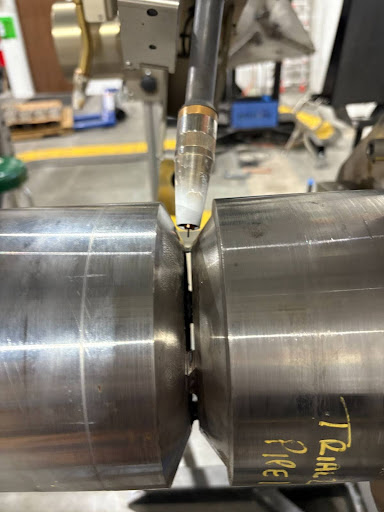
The second trial introduced asymmetrical bevels, pushing the SWR’s limits since the torch cannot rotate mid-weld. Initial lack-of-fusion concerns were resolved by rotating the head of the SWR to 10° (usually reserved for fillet welding) and switching to stringer passes along the sidewall, improving penetration.
The weld required approximately 45–50 minutes of arc time with a total of 12 passes. Radiography again confirmed compliance, with minor porosity indications (0.073–0.097”) well below the maximum permissible 0.125”.
Trial 3: Carbon Steel 6” (DN 150) 60 mm (2.4”) Thick-Wall Challenge
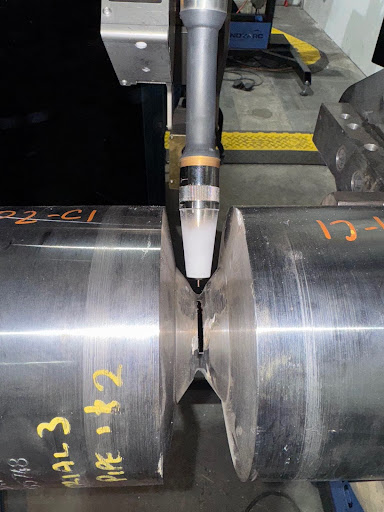
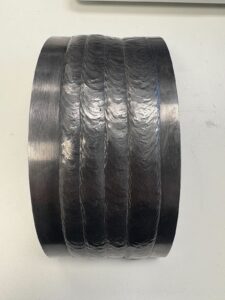
The final trial represented the most difficult scenario, a 60 mm thick forged bar with steep 37.5°/10° bevels on both sides. Welding required 52 passes and roughly 90 minutes total, including utilizing -F adjustments for sidewall fusion.
Despite the demanding geometry, all x-ray inspections passed with zero defects, confirming the SWR’s ability to handle even extreme compound bevel applications.
This application was welded with single wire 0.045” carbon steel ER70S-6 wire. It should be noted that faster weld times and higher deposition can be achieved by implementing Lincoln Electric’s Twin Wire MIG process, Hyperfill. This was not implemented in this case because the company’s next step is to send coupons for stainless steel welding. At this moment, Hyperfill is not available for stainless steel applications on the SWR.
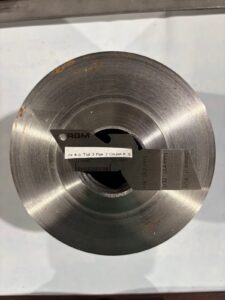
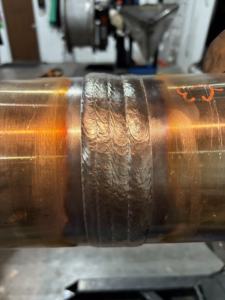
And below is the cutout section of the final weld.
Key Findings and Recommendations
The company’s trials proved that Novarc’s SWR can reliably weld complex, thick-wall joints while maintaining ASME-quality standards. The results highlighted:
The importance of controlling root face (1.5–2 mm) and minimizing back chamfering for optimal fusion.
The SWR’s adaptability in utilizing -F adjustments for torch angles (-10° to +10°) to manage compound bevels.
The potential to further enhance productivity in carbon steel applications using Lincoln Electric Hyperfill, once available for stainless steel.
Next Steps
With the carbon steel phase complete, the project now advances to stainless steel welding trials, a key step toward integrating NovEye Autonomy to further improve weld quality, repeatability, and efficiency for the company’s specialized PCHE manufacturing.
Conclusion
The collaboration between this company and Novarc demonstrates how robotic welding automation is redefining possibilities for thick-wall and high-integrity welds in the energy and process industries. The SWR not only met this company’s rigorous quality expectations but also provided valuable insights for optimizing future procedures across a range of complex joint designs and materials.
FAQ
Q: Why is this trial company important?
A: They are a global leader in Printed Circuit Heat Exchangers (PCHEs) used in demanding industries such as hydrogen, LNG, oil & gas, and carbon capture.
Q: What was the purpose of these trials?
A: To validate that Novarc’s SWR™ can produce high-quality welds on thick-wall, compound bevel joints typical of this company’s production—before transitioning to stainless steel.
Q: What materials and joint types were tested?
A: Three carbon steel trials were performed on pipes ranging from 3” to 6” diameter and 5 mm to 60 mm thickness, including single and dual compound bevels.
Q: How did the SWR perform under these conditions?
A: Exceptionally well. Despite steep bevel angles and varying geometries, all welds met ASME standards with only minor, acceptable porosity indications.
Q: What challenges were encountered?
A: Managing fusion on steep bevel walls due to limited torch rotation. Operators overcame this by adjusting the torch between -10° to +10° and using stringer passes.
Q: How long did each weld take?
A: Arc-on times were 5 minutes and 30 seconds, 45 minutes (30 mm) and 90 minutes (60 mm) for trials 1,2 and 3, respectively, including setup and arm adjustments.
Q: What improvements were recommended?
A: Maintain a consistent 1.5–2 mm land, minimize back chamfering, and explore Hyperfill for faster fill rates (once available for stainless steel).
Q: What are the next steps?
A: Begin stainless steel trials using the same joint configurations, integrating NovEye Assist and Autonomy to enhance precision and repeatability.